CEMA Summit 2026: 3 Priorities for Event Leaders
This summer in Toronto was no different and the Crawford Group team attended and co-led a learning lab on scaling events. The team returned home with pages of notes, conversations that we’re still processing, and one unmistakable signal:
The event industry isn’t simply adapting to change. It’s being fundamentally rewritten.
Rising expectations, pressure to prove business value, and a growing demand for meaningful connection are reshaping how event teams operate. As the pace of change accelerates, sustainable performance will depend less on individual effort and more on the systems behind it.
Here are three takeaways that shaped the conversation at CEMA, and what event leaders should be thinking about next.
1. Make AI Part of the Infrastructure
Attendees wanted to know how to embed AI into existing workflows, where it could create meaningful leverage, and what it would take to move beyond isolated pilots toward lasting adoption.
The examples were specific. Teams are using AI to research client businesses ahead of important meetings, sharpen pitch strategies, and synthesize post-event survey feedback at a scale that was previously difficult to manage. One organization went further, building a chatbot trained on its incoming CMO’s writing style so colleagues could communicate in a way aligned with how that executive processes information.
That’s not a proof of concept. That’s infrastructure.
The panel “Stop Being Useful and Start Being Necessary: How to Be Seen as a Strategic Leader,” featuring Mary Fehrnstrom, Sarah Reed, Debbie Brewer, and Richard Steinau, reinforced this opportunity. AI can make event teams more efficient, but its greater value lies in expanding what they can accomplish.
For event leaders, the goal isn’t simply to save time. It’s to connect workflows, accelerate audience insight, and eliminate manual handoffs that quietly consume capacity. Organizations that build this foundation now will be better positioned to move faster, deliver more, and make a stronger case for future investment.
2. Speak the Language of the Business
Budget pressure and efficiency mandates were recurring themes at CEMA. The message was clear: event leaders must show how their programs contribute to the business.
That means connecting event results to metrics executives already track, pipeline, customer retention, acquisition cost, and lifetime value. If events generate a hypothetical 35% of marketing-qualified leads, that contribution belongs at the center of the executive conversation, not buried in a post-event report.
Strategic influence isn’t something event leaders should wait to be given. It is earned by understanding the business, demonstrating impact, and contributing a valuable perspective with confidence.
3. Design for Access, Not Just Content
One moment at CEMA captured a major shift in attendee expectations.
During a session attendees were asked to identify their primary reason for being at CEMA. Not a single person selected content, while nearly every hand in the room went up for connection.
The takeaway wasn’t that content no longer matters, it was that access to other people is perceived to be the more valuable part of the experience.
Attendees invest time, budget, and internal capital to connect with peers facing similar challenges, hear candid perspectives from senior practitioners, and participate in conversations that are difficult to replicate online. Content may create the reason to gather, but access to others often creates the value people remember.
That changes the role of an event’s design. Connection cannot be treated as something that happens only during breaks or after the formal program ends. It should be built deliberately into the experience through peer exchange, smaller-group conversations, interactive learning labs, candid access to leaders, and formats that invite attendees to contribute rather than simply consume.
For event leaders, community is not an optional benefit surrounding the program. It is part of the infrastructure that helps people learn, adapt, and act with greater confidence
What To Do Next
Conferences create energy and momentum, but both can fade quickly once teams return to their day-to-day work. Turning insight into lasting impact requires clear ownership and deliberate follow-through.
Three practical actions stood out:
- Sharpen your AI context-setting.
- Before using a tool, define the objective, constraints, audience, and decision it needs to support. Better context leads to better output.
- Systematize one workflow.
- Choose a high-friction process and create a repeatable, AI-assisted alternative. One focused improvement can build momentum for broader change
- Connect your events to a metric your CFO or CMO already tracks.
- Choose a measure your CFO or CMO already tracks, and make the connection explicit in reports and internal conversations.
Bottom Line
CEMA Summit 2026 made the path forward clear: move AI from the experimentation phase into everyday workflows, connect event performance to the metrics leadership values, and design experiences around what attendees seek most, meaningful access to one another.
The next chapter of event leadership won’t be defined by who adopts the most tools or generates the most ideas. It will belong to the teams that build the systems, business alignment, and professional networks needed to turn insight into sustained impact.
The shift is already underway. Now is the time to build for it.
Ready to turn these insights into action?
Connect with Crawford Group to build smarter event systems, strengthen the business case for your programs, and design experiences that turn meaningful connections into measurable impact.
More like this
Attention Is Pipeline Currency: How B2B Events Drive Revenue
B2B events are more than engagement opportunities, they’re powerful revenue drivers. By capturing attention, leveraging behavioral insights, and creating meaningful experiences, marketers can uncover buyer intent, accelerate sales conversations, and turn events into measurable pipeline impact.
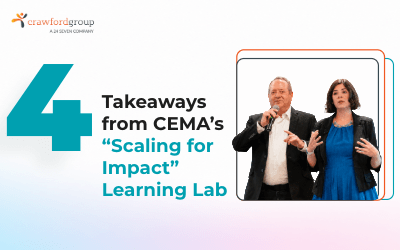
4 Takeaways from CEMA’s “Scaling for Impact” Learning Lab
Scaling an event program takes more than a bigger budget. These four takeaways from CEMA Summit 2026 explore how smarter investments, clear goals, stronger operating models, and connected technology can support sustainable growth.