Attention Is Pipeline Currency: How B2B Events Drive Revenue
At today’s events, attendees’ and buyers’ attention is fragile, it isn’t given; it’s earned.
The executives and practitioners who show up to your events are not fully present by default. They carry live decisions, active escalations, and competing priorities into every session they attend. They made the investment to be there, and they are measuring, in real time, whether the experience justifies it. When it does not, they don’t always leave the room, but they leave in every other sense.
The B2B event landscape is at an inflection point: 82% of marketers expect budgets to rise over the coming year, while 68% now rank events as their most effective marketing channel.
Generic formats, passive content delivery, and disconnected data strategies are no longer a neutral choice. They are a competitive liability.
The future of B2B events won’t be shaped by volume alone.
It will be shaped by experiences that earn attendees’ attention and turn it into measurable commercial momentum.
Attention is Never Guaranteed, Even after Registration
Attendees don’t leave their work at the door. The executives and practitioners sitting in your sessions are still navigating live decisions, managing active escalations, and monitoring inboxes; they’ve simply changed locations. They made the investment to be there because they expected the experience to justify it, and they’re evaluating that assumption in real time from the moment they sit down. If a session fails to resonate and connect with them, their attention migrates, regardless of what the badge scan records.
The data confirms what practitioners already sense. According to Swoogo’s 2025 research, improving attendee engagement ranks as the top challenge event professionals face this year, tied only with securing budget. That symmetry is telling. Getting people in the room is hard. Holding their attention once they arrive is paramount.
When a session feels generic, promotional, or disconnected from what genuinely keeps someone up at night, the response isn’t protest, but they mentally drift away.
The real competition for attention at an event isn’t the booth across the aisle. It’s everything else pressing on their focus, and that list never gets shorter.
Passive Audiences Don’t Create Pipeline
Traditional event design rests on an assumption that has quietly become obsolete: that delivering high-quality information is enough to drive engagement and accelerate pipeline.
It isn’t.
Passive formats, extended keynotes, sequential panels, slide-dense presentations can transfer information. But they rarely create the kind of active involvement that moves a buyer’s thinking forward. Listening is not engaging.
Forrester’s Q1 2026 State of B2B Events Survey puts numbers to the shift: two-thirds of organizations plan to increase workshops, roundtables, and structured networking as attendees increasingly expect to participate, not merely consume content. This isn’t a stylistic preference. It’s a signal that people want to feel implicated in what they’re experiencing, not merely addressed by it.
The events that actually shape pipelines are those where people work through real problems alongside peers who share their context, ask questions without a scripted vendor answer waiting, and leave with something genuinely actionable. Format should serve the engagement objective. When it doesn’t, even excellent content goes to waste.
Personalization Is What Holds Attention
Event attendees are never simply attending. Every session competes with the live demands of their work, and generic content is quickly tuned out.
Personalized agendas, role-specific tracks, and industry-focused discussions signal a clear understanding of what matters to each attendee, turning relevance into attention and attention into action.
Gartner’s 2025 research underscores the commercial impact: personalized interactions make customers 1.8 times more likely to pay a premium and 3.7 times more likely to purchase more than intended.
To generate that kind of impact, personalization must shape the entire event journey, from the first invitation to the final follow-up.
The Future of Event Measurement Is Behavioral Data
Most event measurement gravitates toward what’s easiest to count: registrations, attendance figures, leads captured. These metrics have their place, but they don’t always tell marketers what they most need to know, such as which buyers and attendees are ready to move, and what they care about enough to act on.
The industry is beginning to notice this. Bizzabo’s 2026 State of Events Benchmark Report shows events are increasingly evaluated on pipeline influence, deal velocity, and retention, not just headcount or satisfaction scores. That’s the right direction. But realizing it requires capturing behavioral data that most teams still aren’t systematically collecting.
This gap in data is significant as: 44% of event professionals don’t have their event management platform connected to their CRM, and 69% don’t have it connected to their marketing automation platform. That disconnection means the richest signals events produce, which sessions a prospect prioritized, how long they stayed, what questions they pressed, who they sought out are going uncaptured and unactivated.
Those signals carry real weight. Someone who stayed for a ninety-minute deep-dive and followed it with pointed questions in Q&A represents a fundamentally different conversation than one who appeared briefly and moved on. The data can distinguish between them, but only if it’s being captured, interpreted, and handed to sales within days, not weeks.
Events should function as live intelligence environments. The most valuable thing many of them produce isn’t the content itself. It’s what buyer behavior during the event reveals about where genuine purchase intent exists.
Pipeline Influence Is the New Measure of Event Success
Going forward, the events that move the pipeline will look meaningfully different from those that simply fill rooms. They’ll be built around a clear understanding that buyer attention is finite, competitive, and worth designing for deliberately.
That means treating personalization as structural with agendas that signal to attendees from the moment of invitation that this was built for someone in their position.
It also means treating events as intelligence environments, not just content delivery. Every session a prospect prioritizes, every question they raise, every roundtable they linger in reveals something about where their head is. That behavioral data is only valuable if it’s captured and connected to the tools sales teams actually use, and handed off quickly enough to act on. When it is, events stop being lead generators and start being decision accelerators.
The opportunity is real. Many budgets are growing, live experiences are gaining ground in the B2B mix, and people are showing up willing to engage when the experience earns it. The teams that will make the most of that moment are the ones who stop measuring success by how many people showed up, and start measuring it by how meaningfully the event moved their thinking forward. That’s a shift worth making.
Ready to turn attendee attention into measurable pipeline impact? Connect with Crawford Group to design personalized, insight-driven event experiences that capture buyer intent, accelerate decision-making, and prove the real revenue influence of your events.
More like this
CEMA Summit 2026: 3 Priorities for Event Leaders
CEMA Summit 2026 highlighted three priorities shaping the future of events: embedding AI into everyday workflows, connecting event performance to meaningful business metrics, and designing experiences around what attendees value most—genuine connection. Explore how event leaders can turn these insights into sustainable impact.
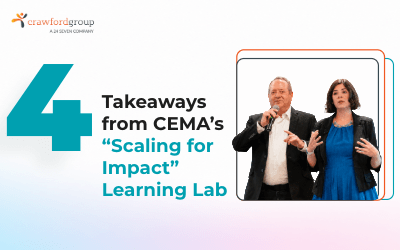
4 Takeaways from CEMA’s “Scaling for Impact” Learning Lab
Scaling an event program takes more than a bigger budget. These four takeaways from CEMA Summit 2026 explore how smarter investments, clear goals, stronger operating models, and connected technology can support sustainable growth.